Orthogonal Subspaces

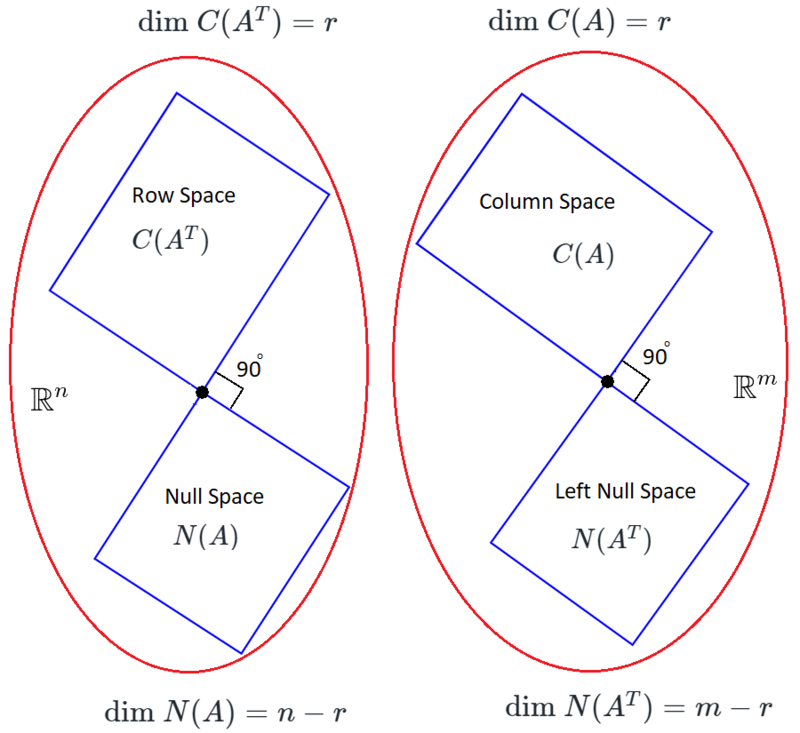
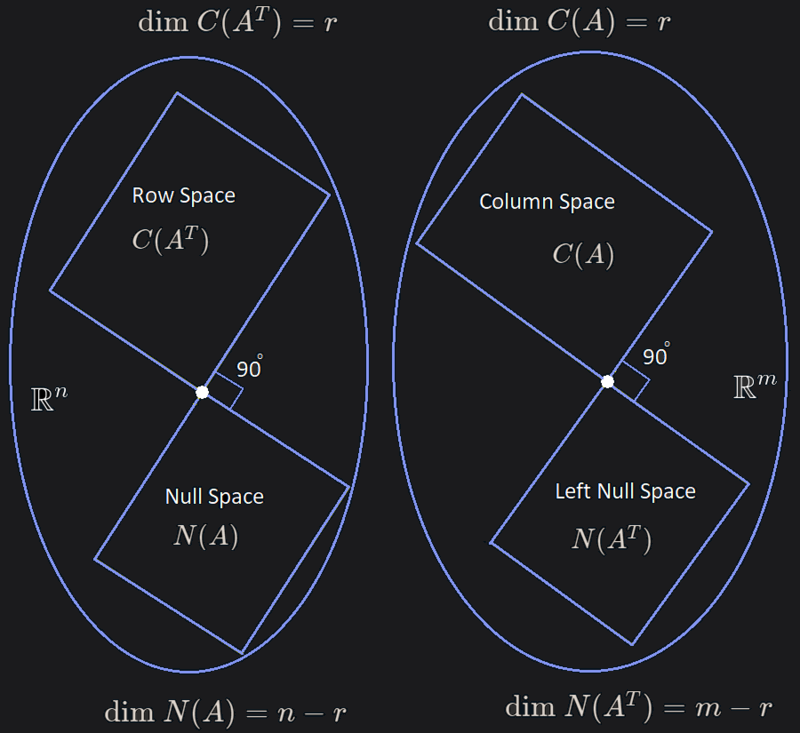
Recall our 44 fundamental subspaces that are,

Fundamental SubspacesFundamental Subspaces

\quad

Orthogonal Vector

Orthogonal means perpendicular, say we have two nn dimensional vectors,

v=[v1v1vn]Rn\vec{v}= \begin{bmatrix} v_1\\v_1\\\vdots\\v_n\\ \end{bmatrix} \in\mathbb{R}^n and w=[w1w1wn]Rn\vec{w}= \begin{bmatrix} w_1\\w_1\\\vdots\\w_n\\ \end{bmatrix} \in\mathbb{R}^n then they are orthogonal if,

vw=0\vec{v}\cdot \vec{w}=0

OR

vTw=0\vec{v}^T \vec{w}=0
info

0\vec{0} is orthogonal to every vector.

Pythagoras right angles triangle

note

Say we have two nn dimensional vectors

x=[x1x1xn]Rn and y=[y1y1yn]Rn\vec{x}= \begin{bmatrix} x_1\\x_1\\\vdots\\x_n\\ \end{bmatrix} \in\mathbb{R}^n \text{ and } \vec{y}= \begin{bmatrix} y_1\\y_1\\\vdots\\y_n\\ \end{bmatrix} \in\mathbb{R}^n

then the vectors x,y,x+y\vec{x}, \vec{y}, \vec{x}+\vec{y} form a right angles triangle if, x\vec{x} and y\vec{y} are orthogonal IF.

xTy=0\vec{x}^T \vec{y}=0

According to Pythagorean theorem,
x2+y2=x+y2;\|\vec{x}\|^2 + \|\vec{y}^2\| =\|\vec{x}+\vec{y}\|^2;\quadif x and y are orthogonal\color{DC143C}{\text{if }\vec{x} \text{ and } \vec{y} \text{ are orthogonal}}

xTx+yTy=(x+y)T(x+y)xTx+yTy=(xT+yT)(x+y)xTx+yTy=xTx+xTy+yTx+yTyxTx+yTy=xTx+xTy+yTx+yTyxy+yx=0xTy=0\Rightarrow \vec{x}^T\vec{x} + \vec{y}^T\vec{y} =(\vec{x}+\vec{y})^T(\vec{x}+\vec{y}) \\ \Rightarrow \vec{x}^T\vec{x} + \vec{y}^T\vec{y} =(\vec{x}^T+\vec{y}^T)(\vec{x}+\vec{y}) \\ \Rightarrow \vec{x}^T\vec{x} + \vec{y}^T\vec{y} = \vec{x}^T\vec{x} + \vec{x}^T\vec{y} + \vec{y}^T\vec{x} + \vec{y}^T\vec{y} \\ \Rightarrow \vec{x}^T\vec{x} + \vec{y}^T\vec{y} = \vec{x}^T\vec{x} + \vec{x}^T\vec{y} + \vec{y}^T\vec{x} + \vec{y}^T\vec{y} \\ \Rightarrow \vec{x}\cdot\vec{y} + \vec{y}\cdot\vec{x} = 0 \\ \Rightarrow \vec{x}^T\vec{y} =0
xTy=0;if x and y are orthogonal\Rightarrow \color{318CE7}{\vec{x}^T\vec{y} =0};\quad \color{DC143C}{\text{if }\vec{x} \text{ and } \vec{y} \text{ are orthogonal}}

Orthogonal Subspaces

We do understand orthogonal vectors, but what are orthogonal subspaces.
What is it meant for two subspaces to be orthogonal?
Let's consider two subspaces S\mathbb{S} and U\mathbb{U}.
S\mathbb{S} and U\mathbb{U} are orthogonal if,

note

Every vectors in S\mathbb{S} is orthogonal to every vectors in U\mathbb{U}.

Example,

note

For a 3-Dimensional space are X-Y plane and X-Z plane orthogonal?
NO, consider two vectors,

xXY=[110]Rn, yYZ=[011]Rn\vec{x}_{XY}= \begin{bmatrix} 1\\1\\0\\ \end{bmatrix} \in\mathbb{R}^n, \ \vec{y}_{YZ}= \begin{bmatrix} 0\\1\\1\\ \end{bmatrix} \in\mathbb{R}^n

and xXYyYZ0\vec{x}_{XY}\cdot\vec{y}_{YZ}\neq 0 so they are not orthogonal to each other.

info

If two subspaces meet on some vector then they are not orthogonal, except 0\vec{0}.

Row space is orthogonal to null space

Say that we have a m×nm\times n matrix AA, then,
All vectors say x\vec{x} is in the null space if Ax=0A\vec{x}=\vec{0}
This tells us that x\vec{x} is orthogonal to all row vectors.

note

Let's denote the ith row as rir_i.

A=[r1r2rm]A=\begin{bmatrix} \cdots r_1 \cdots\\ \cdots r_2 \cdots\\ \vdots\\ \cdots r_m \cdots\\ \end{bmatrix}\quad

so,

Ax=0[r1r2rm][x1x2xn]=[000]A\vec{x}=0\equiv\begin{bmatrix} \cdots r_1 \cdots\\ \cdots r_2 \cdots\\ \vdots\\ \cdots r_m \cdots\\ \end{bmatrix} \begin{bmatrix} x_1\\x_2\\\vdots \\ x_n\\ \end{bmatrix} = \begin{bmatrix} 0\\0\\\vdots \\ 0\\ \end{bmatrix}
[r1Txr2TxrmTx]=[000]\Rightarrow \begin{bmatrix} r_1^T x\\r_2^T x\\\vdots \\ r_m^T x\\ \end{bmatrix} = \begin{bmatrix} 0\\0\\\vdots \\ 0\\ \end{bmatrix}
riTx=0; i={1,2,,m}\Rightarrow r_i^Tx=0;\quad \forall\ i=\{1,2,\cdots,m\}

So xx is orthogonal to all row vectors.

We said that xN(A)\vec{x}\in N(A) is orthogonal to all row vectors.
But this doesn't mean that null space is orthogonal to the row space.
For that we need to check for all of the linear combinations of row vectors.
If all of the linear combinations of row vectors are orthogonal to xN(A)\vec{x}\in N(A), then we can say that Row space is orthogonal to Null space.

note

We discovered that

riTx=0; i={1,2,,m}r_i^Tx=0;\quad \forall\ i=\{1,2,\cdots,m\}
ciriTx=0; i={1,2,,m} and ciR\Rightarrow c_ir_i^Tx=0;\quad \forall\ i=\{1,2,\cdots,m\} \text{ and } c_i\in\mathbb{R}

so any combination of ciriTx=0c_ir_i^Tx=0.
So we can see that linear combinations of row vectors are orthogonal to xN(A)\vec{x}\in N(A).

info

Now we can say that Row space is orthogonal to Null space.

Column space is orthogonal to left null space

Say that we have a m×nm\times n matrix AA, then,
All vectors say x\vec{x} is in the left null space if ATx=0A^T\vec{x}=\vec{0}
This tells us that x\vec{x} is orthogonal to all column vectors.

note

Let's denote the ithi^{\text{th}} column as cic_i.

A=[c1c2cn]A=\begin{bmatrix} \vdots & \vdots & & \vdots \\ c_1 & c_2 & \cdots & c_n \\ \vdots & \vdots & & \vdots \\ \end{bmatrix}\quad

so,

ATx=0[c1c2cn][x1x2xm]=[000]A^T\vec{x}=0\equiv\begin{bmatrix} \cdots c_1 \cdots\\ \cdots c_2 \cdots\\ \vdots\\ \cdots c_n \cdots\\ \end{bmatrix} \begin{bmatrix} x_1\\x_2\\\vdots \\ x_m\\ \end{bmatrix} = \begin{bmatrix} 0\\0\\\vdots \\ 0\\ \end{bmatrix}
[c1Txc2TxcnTx]=[000]\Rightarrow \begin{bmatrix} c_1^T x\\c_2^T x\\\vdots \\ c_n^T x\\ \end{bmatrix} = \begin{bmatrix} 0\\0\\\vdots \\ 0\\ \end{bmatrix}
ciTx=0; i={1,2,,n}\Rightarrow c_i^Tx=0;\quad \forall\ i=\{1,2,\cdots,n\}

So xx is orthogonal to all column vectors of AA.

We said that xN(AT)\vec{x}\in N(A^T) is orthogonal to all column vectors.
But this doesn't mean that left null space is orthogonal to the column space.
For that we need to check for all of the linear combinations of column vectors.
If all of the linear combinations of column vectors are orthogonal to xN(AT)\vec{x}\in N(A^T), then we can say that column space is orthogonal to left null space.

note

We discovered that

ciTx=0; i={1,2,,n}\Rightarrow c_i^Tx=0;\quad \forall\ i=\{1,2,\cdots,n\}
αiciTx=0; i={1,2,,n} and αiR\Rightarrow \alpha_ic_i^Tx=0;\quad \forall\ i=\{1,2,\cdots,n\} \text{ and } \alpha_i\in\mathbb{R}

so any combination of αiciTx=0\alpha_ic_i^Tx=0.
So we can see that linear combinations of column vectors are orthogonal to xN(AT)\vec{x}\in N(A^T).

info

Now we can say that Column space is orthogonal to Left null space.