Column Space
We discussed that a space is a vector space, if all linear combination of vectors (that are inside that space) lies in that space.
But what is this Column space? We know what is space, but what we meant by Column?
Here Column is referring to Column of a matrix.
Example in 3D vector space
Consider a matrix
here each column is considered as a vector.
Matrix has columns so we have vectors, say
Column space of matrix is defined by the vector space of these vectors and vector space of is all the linear combinations of vectors and .
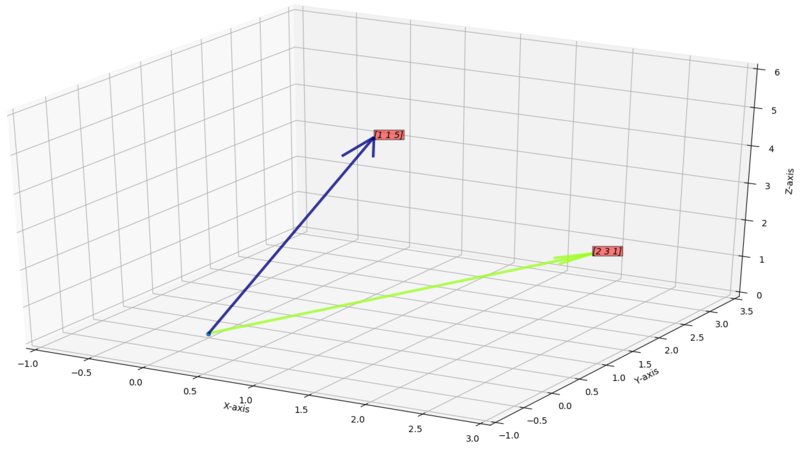
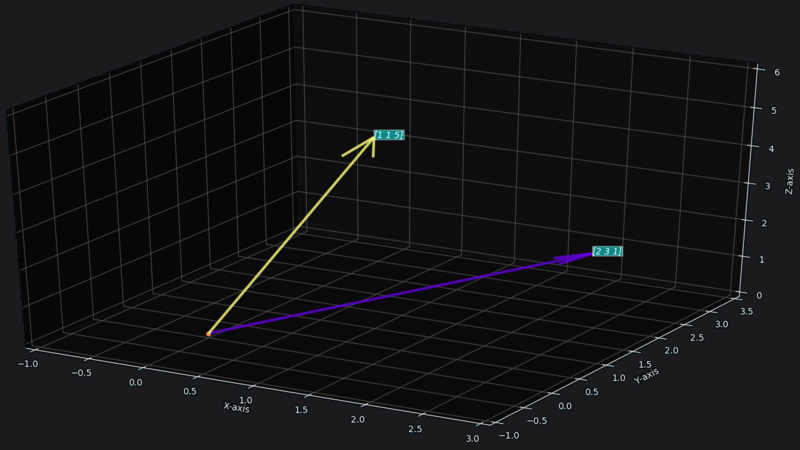
How does that vector space look like?
Here we can see and are non-parallel vectors so vector space of and is a plane.
Equation of plane
General equation of plane is we know this plane passes through origin so , and
is normal to plane which we can get by taking cross product between and .
so equation of plane is,
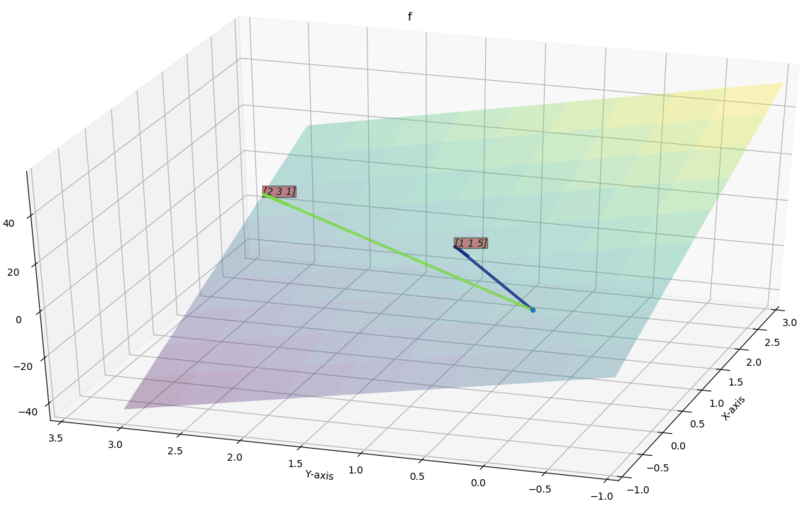
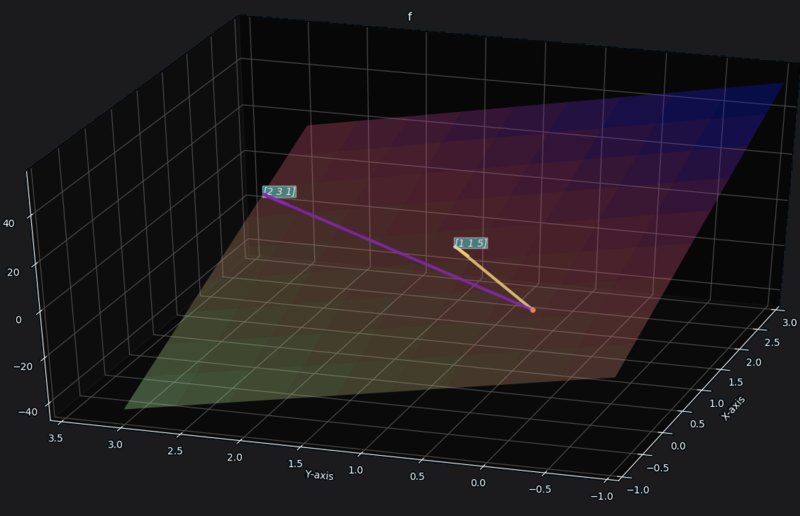
Code To plot this (python)
import MultiVariable as mvar
import numpy as np
%matplotlib qt
def f(x,y):
    return 14*x - 9*y

m = mvar.MultiVariable(count=10, x_range=(-1,3), y_range=(-1,3))
vectors = np.array([
                    [1,1,5],
                    [2,3,1],
                    ])
origin = np.array([0,0,0])
m.plot_3D_vectors(vectors, origin, plot_separately=False)
m.plot_surface_color_3D(f,plot_separately=False, alpha=0.3)
m.setX_limit((-1,3))
m.setY_limit((-1,3.5))
Example in 4D vector space
Consider a matrix
here each column is considered as a vector.
Matrix has columns so we have vectors, say
So we have -dimensional vectors.
So
Column space of matrix is defined by the vector space of these vectors and vector space of is all the linear combinations of vectors and .
How does that vector space look like?
Does it fill the whole 4-dimensional space?
We have vectors in and we can't fill a dimensional space with just vectors,
doesn't matter how they are oriented.
So the answer is No
Does it fill a 3-dimensional space?
Here you can see that , so lives in vector space of and
So in total we have just vectors and and we can't fill a dimensional space
with just 2 vectors, we at least need (non-parallel) vectors to fill a -dimensional space.
So answer is No
Does it fill a 2-dimensional space?
Here you can see that , so lives in vector space of and
, and, and are non-parallel vectors so vector space of and is a plane.
Combined all of that vector space of , and is a plane Column space of matrix is a plane.
So answer is Yes vector space of and fills a -dimensional space?
Column space of a matrix is defined by all the linear combinations of it's column vectors. Here we will denote the column space of matrix as
Matrix Notation
We saw how we can find Column space using columns as vectors.
Now let's find Column space of some matrix in matrix notation.
Say we have a matrix
Now answer this,
Does always have a solution for every ?, and if the answer is No then which do have a solution?
if is a matrix, then is a vector and is vector.
Say our matrix is then
Does always have a solution for every ?
Here we have 3 variables and 4 equations so, one of the depends on one of and
So we can't have solution for every , because of this dependency. So it rules out the possibility of dimensional column space.
Because to be a Column space we must get every vector in that column space by the linear combinations of column vectors.
What are the that are possible?
Ok we can't solve it for every but we can solve it for some .
For example:
For
For
For
For
Now you can see that the that can solve this system of equation is the that is in the column space of matrix .
So is the linear combination of columns of matrix
Dependency
You can see that in our matrix
there is a column that we can get with linear combination of other columns.
(here I represent column as )
So is in the vector space of and .
In above example if we remove one of the column from matrix then the column space of matrix A will still be same.
say we drop column (We can drop column or column)
So say
Then will also give all possible that can.
So we can say that
Column space of and are same,
But we can't drop two columns from because any two columns in our matrix are independent of each other.
So we can say that Column space of matrix is a -dimensional subspace inside -dimensional space.